
Cirque Haus: an aerial business where nobody teaches you anything
In a city full of aerial and circus programs, a Midtown Manhattan training facility built around open access and professional-grade infrastructure is filling a gap the NYC circus community didn't know how to articulate — until it existed.
Most aerial businesses solve the same problem: how do we get beginners through the door, teach them progressively, and turn them into long-term students? CirqueHaus, located on West 38th Street in Midtown Manhattan, is solving a different problem entirely — one that sits at the other end of the pipeline. What do experienced aerialists, acrobats, and movement artists do when they need to train, but don't have a space?
The answer CirqueHaus offers is a 5,500 square foot facility with 30-foot ceilings, professional rigging, matted floors, and a simple proposition: buy a pass, show up, and train. No class schedule to work around. No waiting for a beginner cohort to catch up. Just the space, the infrastructure, and however many hours you need.
“It’s the kind of space that makes aerialists ask, why didn’t this exist before?”
The open training model
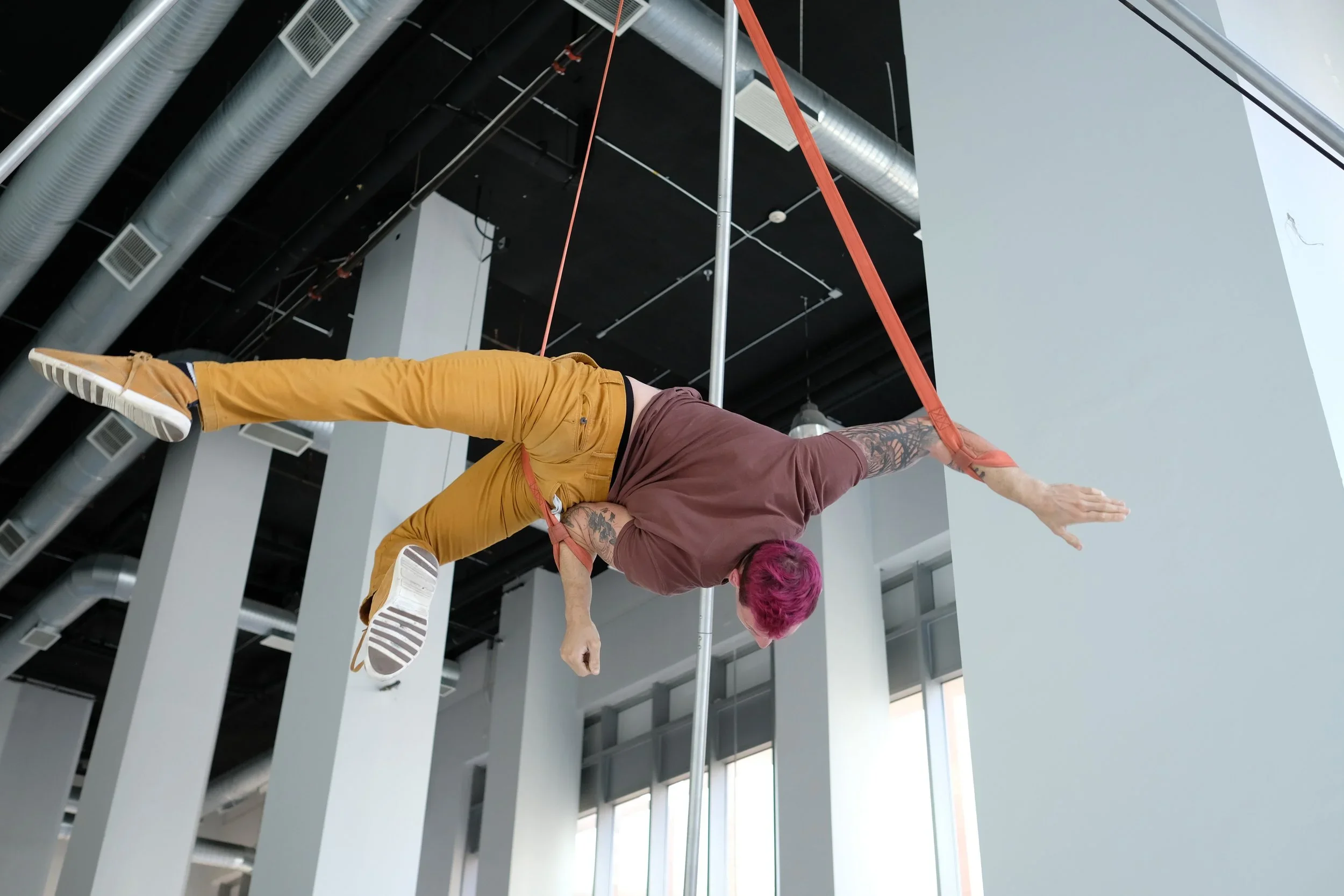
CirqueHaus describes itself explicitly as an open training facility, not a class studio — and the distinction matters more than it might seem. The class model, which dominates almost every aerial and circus school, ties training to instructor availability, group schedules, and curriculum progressions. That works beautifully for developing students. But for working performers, competitive athletes, freelance instructors, and advanced practitioners, it creates real friction. You can't always train when the class is. You don't always need the class.
CirqueHaus removes that friction. The space is open daily from 6 am to 10 pm. Members and day pass holders can walk in, claim a rigging point, and train independently — or bring a private instructor of their choosing. The facility runs an instructor approval process for anyone who wants to teach there, which keeps quality standards intact without requiring everyone to work through a single school's curriculum.
This has a meaningful implication for the broader NYC aerial ecosystem: CirqueHaus effectively acts as neutral ground. It's not competing with class studios for students — it's complementing them, serving the people those studios have already trained.
The infrastructure
The facility is built to professional training standards. The aerial rig features 8 to 10 rigging points operating on a pulley system, and the space stocks a limited set of shared apparatuses — silks, straps, and lyras — available on a first-come, first-served basis for those who don't bring their own. Members can store personal equipment on site. The floor plan includes over 3,000 square feet of matted space for acrobatics, partner work, and hand balancing, plus cross-training weights and a variety of specialist tools — handstand blocks and canes, mobility equipment, yoga mats.
There's also a co-working area, which is a small but telling detail. It suggests CirqueHaus understands that many of its users are self-employed performers and coaches who blur the line between training and working — people who might need to answer emails between sets on the silks.
“The facility acts as neutral ground — not competing with class studios for students, but serving the people those studios have already trained.”
Access tiers, honestly priced
The pricing structure is tiered to match different training relationships with the space. A $45 day pass gets you in the door for a single session. A 7-day pass at $150 suits visiting artists or those trying the space before committing. The non-renewing 30-day pass at $350 works for people in town temporarily or between longer commitments. And the monthly membership at $295 — with a 3-month minimum — is designed for the serious regular: it includes unlimited open training, equipment storage, free access to jams and shows, and discounts on private lessons, workshops, and events. Warrior Bridge classes are also included, adding a structured movement practice to what is otherwise a self-directed setup.
Day Pass $45 - Single session access
7-Day Pass - $150 - Great for visiting artists
30-Day Pass- $350 - Non-renewing, no commitment
Monthly Membership - $295 - 3-month min · storage + perks included
Community, not just access
What CirqueHaus has built around the facility infrastructure is as interesting as the facility itself. Regular Open Stage shows give members and community artists a low-stakes venue to share work in progress — a genuinely rare thing in a city where performance space is expensive and competitive. The annual CirqueHaus Festival brings in international circus educators for a multi-day intensive covering acrobatics, handstands, flexibility, and partner work, drawing both locals and visiting artists from out of town. Members get discounted or free access to both.
This events layer transforms CirqueHaus from a training space into something closer to a circus hub — a place where the NYC aerial and acrobatics community converges not just to train, but to watch, perform, learn, and connect. With 20,000 followers on Instagram, the reach extends well beyond whoever can make it through the door on any given day.
What the model means for the industry
For studio owners, CirqueHaus is worth studying even if you never plan to replicate it. It represents a clear-eyed answer to a specific market need — the professional and advanced practitioner who has outgrown the class model but still needs infrastructure. In most cities, that person has nowhere purpose-built to go. They cobble together access: renting time in dance studios not designed for aerial, training in spaces with inadequate ceiling height, or squeezing sessions into class studios during off-hours.
CirqueHaus is a reminder that the aerial arts industry has more than one customer type, and that building for the advanced end of the spectrum — the performers, coaches, and serious hobbyists — is a legitimate and underserved business. In a city as dense with circus talent as New York, it works. Whether it translates to other markets is an open question, but the model itself deserves attention.