
Aerial City built a circus school. Then it kept going.
Most aerial studios are in the business of teaching. Aerial City, operating across two Texas locations, is in the business of circus. Classes are just one part of how they pull it off.
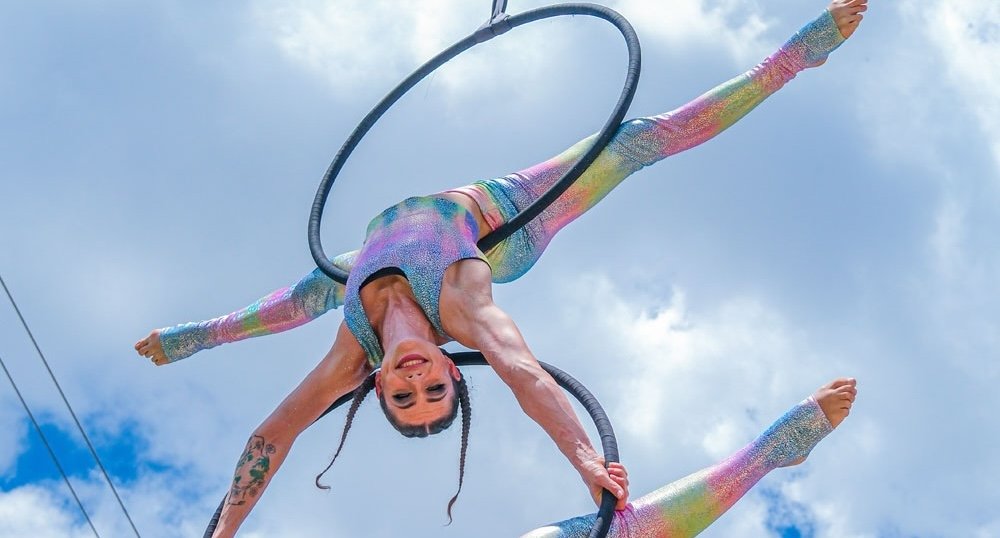
There's a version of an aerial studio that stays in its lane: group classes, a structured curriculum, maybe some open gym time. That model works, and it works well. Aerial City, based in the San Antonio metro area with locations in Converse and San Antonio proper, has clearly thought about that model — and then built something considerably wider.
The studio offers classes spanning pole dancing, aerial arts, aerial silk, aerial hammock, aerial yoga, lyra, acro yoga, trapeze, aerial rope, dance, Cyr wheel, fire and flow arts, and circus arts, from beginners through to advanced practitioners. aerialcitytexas But it also books performers for corporate events and weddings, hosts private group parties, and runs monthly community jams that pull together aerialists, fire spinners, and flow artists under the same roof.
For studio owners watching from elsewhere, the question Aerial City implicitly raises is one worth sitting with: how wide can you go before things start to fray? Their answer, at least so far, seems to be: wider than most people try.
The multi-revenue model
What makes Aerial City structurally interesting isn't just the breadth of classes — it's that the studio has built multiple distinct revenue streams that reinforce each other in ways that are worth unpacking.
The entertainment hire operation covers aerialists, fire performers, stilt walkers, and more, for corporate events, birthdays, weddings, and parties. aerialcitytexas The private group party offering turns the studio itself into an event venue for birthdays, bachelorettes, and team building. And the monthly jam is something rarer still — a recurring first-Sunday event from 6–9pm bringing together aerial, acro yoga, fire and flow, with all props welcome, fuel provided, and fire and aerial safety staff on site. aerialcitytexas
Each of these arms feeds the others. The entertainment hire operation means the studio is producing working performers whose skills were almost certainly developed in the class program. The private parties introduce new people to aerial arts in a low-stakes context, many of whom become students. The community jams pull in practitioners from outside the studio's own ecosystem, broadening the network and keeping the space alive beyond the regular schedule. This is a flywheel rather than a single engine — and it's still relatively rare in the aerial world, where most studios are class-first and everything else is secondary.
The fire and flow dimension
One of the most distinctive aspects of Aerial City is how fully it has committed to fire and flow arts as a core part of its identity, not an add-on. Fire performance is taught through private lessons and workshops with an 18+ requirement and proper safety protocol. The monthly jam specifically brings fire and flow front and center alongside aerial and acro yoga, and the entertainment hire roster features fire performers prominently.
This matters because fire arts have historically existed in a separate community from aerial. Studios that bridge the two create something different: a space where a circus generalist can exist, training across disciplines in a single community rather than bouncing between separate scenes. In the San Antonio metro, Aerial City appears to be one of the only studios offering that kind of cross-disciplinary home.
Two locations, one identity
Classes are open to all age groups 7 and up, including adults, with instructors focused on appropriate level training in a welcoming and supportive environment. aerialcitytexas That consistency of tone — accessible, community-forward, serious about safety — runs across both locations and the full span of programming, from a beginner's first lyra class to a fire performance at a corporate gala.
Operationally, running fire arts, aerial, acro yoga, Cyr wheel, and a hire entertainment business simultaneously across two locations is genuinely complex. The fact that Aerial City has managed to do so without obviously narrowing its offering suggests operational maturity worth noting — particularly for any studio owner contemplating their own expansion.
The community jam as a strategic asset
It's worth pausing on the monthly jam specifically, because it's one of those programming decisions that looks like a community gesture but is actually quite smart business. By hosting a recurring open event with safety staff on site, Aerial City is doing several things simultaneously: keeping its space activated on a Sunday evening, drawing in practitioners who may not be regular students, positioning itself as the regional hub for circus culture broadly defined, and creating a recurring reason for the wider community to walk through the door.
Very few studios run a fire jam with dedicated safety staff on a monthly basis. It's logistically demanding and carries real responsibility. The fact that Aerial City does it is a signal about their ambitions — and about the kind of community they're trying to build.
In a region where circus arts are still finding their footing as a mainstream culture, that kind of anchor matters. Aerial City isn't just serving the aerial community in the San Antonio area. It's building it.